Posts

A Few Thoughts on Christmas

Image
It's frozen out there, blistering cold.  To put it frankly, it is cold as balls.  Certainly, it seems as if the Earth itself were trying to kill us as its fruits recede into dried yellow grass and bare skeletal branches to deny sustenance to the living, while the cold alone could be enough to take a man without shelter or sufficient coverings.  It's a time of year that, taken on its own terms, brings to the fore the uncomfortable mortality of our existence, and yet, in our indomitable human spirit, generations before have seen fit to reform the world before our eyes into one more tolerable. Christmas is technically a Christian holiday, but at this point, it's also a cultural holiday outside of that.  There's a whole history to the December date and festive traditions, much of which has to do with the early Christians adapting the pagan pre-Christian festivals surrounding the winter solstice, like Yule and Saturnalia, but whether you take it literally or symbolical...

County Names

Image
There have been 29 counties in the state of Utah since the creation of Daggett as the 29th county in 1918, but when the Utah Territory was created in 1850, there were only 10.  Over the course of several decades, these 10 were reshaped, with portions broken off to form other counties for matters of practicality and redistricting, eventually resulting in the current map of 29.  Even in the midst of all this, another 10 counties were established and then either dissolved or absorbed into the boundaries of other counties or even other states.  Of these 10 no longer existing counties of Utah were: Carson Established in 1854, Dissolved in 1861   Named for the Carson River (that named after the famous explorer Christopher "Kit" Carson), Carson County originally dissolved in 1857, then re-established in 1859 before it became part of the Nevada Territory created in 1861. Cedar Established in 1856, Dissolved in 1862   Named for the juniper trees historically com...

Massasoit

Image
If you were to visit the Utah State Capitol in Salt Lake City, you might notice a statue of a American Indian man in front of the east doors of the white granite, Corinthian-style domed capitol building.  Cast in bronze, he's tall and muscular, skimpily dressed in a breechcloth and moccasins, with a peace pipe held in the crook of one arm and an eagle pitched upright in his hair.  The statue, created by Springville, Utah-born sculptor Cyrus Dallin, portrays Massasoit, the Pokanoket Rhode Island chief who initiated relations with the Plymouth pilgrims in Massachusetts in 1621.  It doesn't seem strange, at first glance, that an American Indian leader would be depicted in statue on Utah's capitol grounds, considering the prominent role of indigenous people's in Utah history, but Massasoit, as far as is known or at all probable, never saw the land we now call Utah.  Why not a statue of any of the significant native leaders from Utah's history such as Walkara, who invi...

Utah Macabre: Punjun Spring

Image
In late September 1776, a Spanish exploratory expedition led by two priests of the Franciscan Order, Atanasio Dominguez and Silvestre Vélez de Escalante, entered the Utah Lake Valley.  After a few days spent exchanging gifts with the Timpanogos people who occupied the valley, they made a stop at a natural spring along the ancient highway that American Indians had used for generations to travel around the lake to the Juab Valley and further south to the southern regions of the Pahvant, the Paiute and the Navajo.  They were about 20 miles south from Utah Lake at a spring the Spanish priests named it Ojo de San Pablo , or the "Eye of Saint Paul."  They didn't tarry long.  The Utes called it "Punjun."  Punjun Spring, it is said, is without bottom, and sometimes, on the quiet nights, they could hear the sound of a baby's cry emanating from its depths.  2,188 miles to the east, the American Revolutionary War was raging, and 21-year-old Nathan Hale was arrested ...

Utah Macabre: Frisco

Image
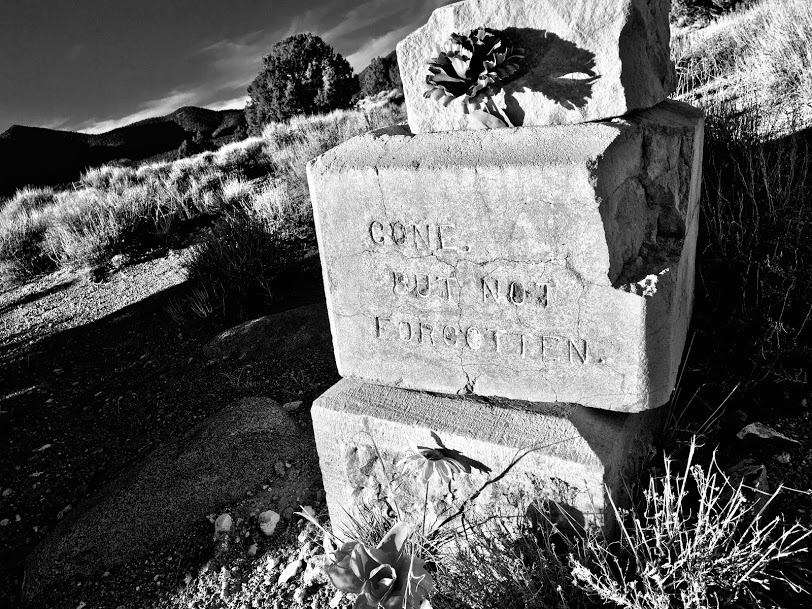
45 minutes west from Beaver, Utah is a silent piece of rugged desert land in the foothills of Utah's San Francisco Mountains, out in the middle of nowhere.  14 miles one way is Milford, Utah, the population of which the United States Census Bureau estimates at 1,348 people.  61 miles the other way is Garrison, Utah, a 200-person town on the Nevada border.  All is wilderness in between.  Here in the San Francisco Mountain foothills in the Sevier Desert are the ruins of a once wild and bustling town called Frisco.  Frisco sprouted up in 1870s, fueled by the fabulously rich Silver Horn mine that yielded thousands of tons of ore worth tens of millions of dollars during its peak years from 1875 to 1885.  People came from all over the world in an attempt to claim their fortunes, make a half-decent living, or just to have a good time.  In the middle of a desert where no one would want to live for almost any reason other than potential riches, water had to ...