Posts

A Place in Time: Utah History in Context - 13000-12500 B.C.
Image
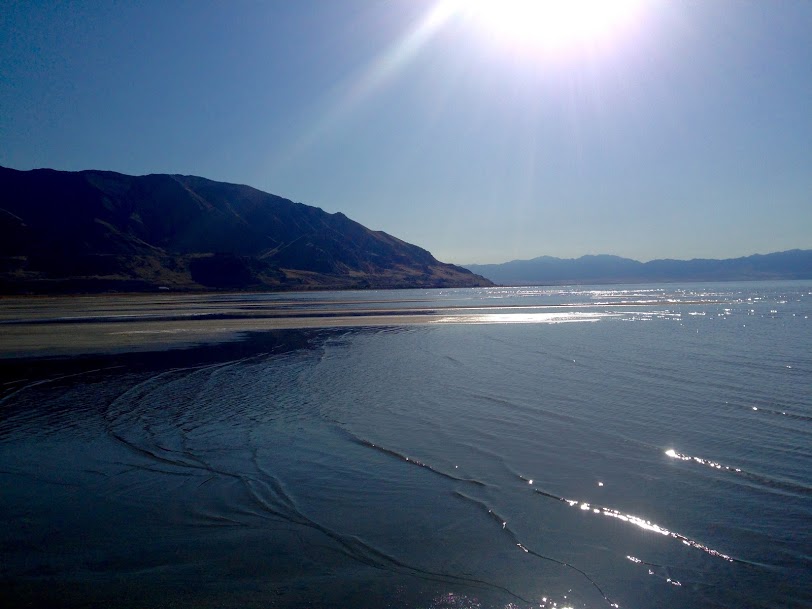
The Great Salt Lake 15,000 years ago, before any humans are known to have inhabited the area, Lake Bonneville covers some 32,000 square miles from its northern tip in Southern Idaho to its southern tip in Southern Utah, and its western extremity in Eastern Nevada to its eastern extremity in Central Utah.  At its maximum depth, it is over 980 feet deep.  The climate is cool and wet, and the valleys in Utah west of Wasatch Mountains are submerged deep under the lake.  After recent lava flows have diverted the flow of rivers in Southeastern Idaho into the lake, Bonneville's levels rise even higher, seeping through the barrier at the Portneuf and Bannock Mountains.  At first the leaking is gradual, until suddenly one day, the barrier is broken.  The massive power of Lake Bonneville is unleashed at 33 million cubic feet per second in a 410-foot wave, blasting through the Snake River Plain at 70 miles per hour and reshaping the land.  The 600-foot Snake Rive...

A Place in Time: Utah History in Context - 1200-1300 A.D.

Image
Medieval Castles in Utah Utah, 13th Century A.D. At an unknown date, sometime between A.D. 1200 and 1300 (according to the National Park Service), during what is called the Pueblo III Period, the Ancestral Pueblo people (also known as "Anasazi") were constructing multi-story stone towers that still stand to this day in the Four Corners area.  Their culture in the area dated back to the around 500 A.D., but around 1100, their communities transitioned from mesa tops to canyons.  One cluster of villages comprising about 2,500 people, now called "Hovenweep" (from a Paiute/Ute word meaning "deserted valley"), is built overlooking the canyons around the Cajon Mesa of the Great Sage Plain near the southern end of Utah's and Colorado's shared border.  The exact purpose of their brick structures is no longer known, whether they were homes, defensive structures, observatories or something else entirely.  Not all that long after, toward the end of the ...

Four Years in the Wilderness: Clarion and Utah's Jewish Heritage

Image
Out a ways from a unpaved road west of Centerville, Utah (about 130 miles south of Salt Lake City), if you have enough time or know what to look for, you can find a couple of lone grave stones standing isolated upon a dusty knoll overlooking the Gunnison Valley.  Each of these protected by guardrails, and each has words written in Hebrew and in English.  A little ways west of these markers, closer to the road, are the remnants of a town, cement foundations and scattered bricks left over from would-be homes; dreams that died in the desert.  It was once called "Clarion," and some call it that still. As a remarked in a newsletter published by the Jewish Telegraphic Agency in February 1928, "Salt Lake City is of particular interest to Jews since it is, perhaps, the only place in the world where Christians call themselves Jews and Jews are often called "Gentiles.""  Zion was a preoccupation of early Mormonism, in which it was an almost abstract concept with ...

A Few Thoughts on Christmas

Image
It's frozen out there, blistering cold.  To put it frankly, it is cold as balls.  Certainly, it seems as if the Earth itself were trying to kill us as its fruits recede into dried yellow grass and bare skeletal branches to deny sustenance to the living, while the cold alone could be enough to take a man without shelter or sufficient coverings.  It's a time of year that, taken on its own terms, brings to the fore the uncomfortable mortality of our existence, and yet, in our indomitable human spirit, generations before have seen fit to reform the world before our eyes into one more tolerable. Christmas is technically a Christian holiday, but at this point, it's also a cultural holiday outside of that.  There's a whole history to the December date and festive traditions, much of which has to do with the early Christians adapting the pagan pre-Christian festivals surrounding the winter solstice, like Yule and Saturnalia, but whether you take it literally or symbolical...

County Names

Image
There have been 29 counties in the state of Utah since the creation of Daggett as the 29th county in 1918, but when the Utah Territory was created in 1850, there were only 10.  Over the course of several decades, these 10 were reshaped, with portions broken off to form other counties for matters of practicality and redistricting, eventually resulting in the current map of 29.  Even in the midst of all this, another 10 counties were established and then either dissolved or absorbed into the boundaries of other counties or even other states.  Of these 10 no longer existing counties of Utah were: Carson Established in 1854, Dissolved in 1861   Named for the Carson River (that named after the famous explorer Christopher "Kit" Carson), Carson County originally dissolved in 1857, then re-established in 1859 before it became part of the Nevada Territory created in 1861. Cedar Established in 1856, Dissolved in 1862   Named for the juniper trees historically com...