Posts

The Civil War That Almost Was: The Utah War in 16 Events

Image
On June 19, 1858, the New York Herald reported on the culmination of the major military expedition to the Utah Territory that had begun a year before, "Killed, none; wounded, none; fooled, everybody."   The Utah War (1857-1858) was considered an anti-climactic blunder on the part of the highly polarized United States government at the time.  Although it came to be called the Utah War, and it very nearly came to something fitting to be called that, the sending of U.S. Army troops was not intended to start a war or necessarily to suppress a rebellion, because when he ordered it, President James Buchanan did not expect an armed resistance to his appointing of a territorial governor or the sending of troops to protect the routes of emigration and trade.  Yet, there were those killed and wounded, and from the Utahn perspective, the Utah War presents a disturbing cautionary tale of the perils in extreme and insular rhetoric, and of the cycle of violence.  What was deri...
The Golden Spike, Utah and the World of 1869

Image
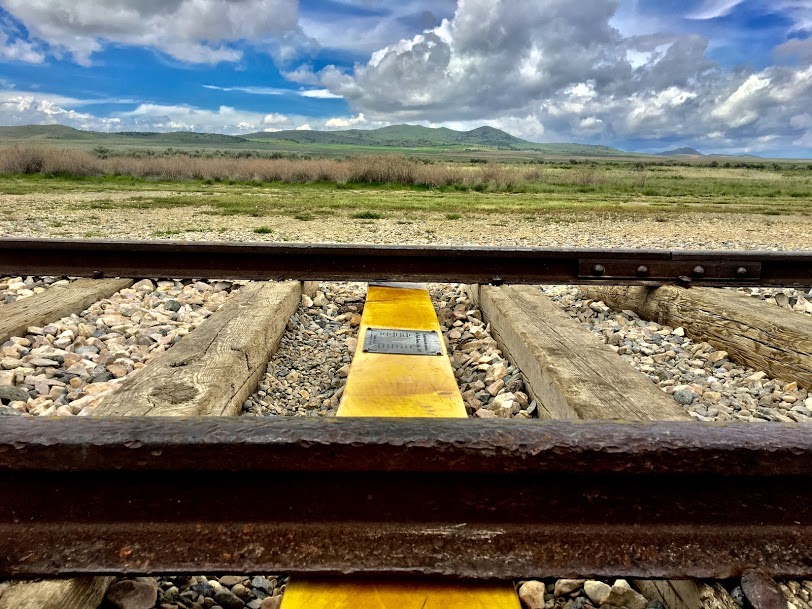
This year marks the 150th anniversary of the First Transcontinental Railroad, completed on May 10, 1869 at Promontory, Utah in a ceremony that joined 1,087 miles of Union Pacific Railroad (UPRR) track (originating at Council Bluffs, Iowa) to 690 miles of Central Pacific Railroad (CPRR) track (originating in Sacramento, California).  CPRR President Leland Stanford (former Governor of California and later founder of Stanford University) used a silver maul to tap a ceremonial final spike made of copper-alloyed gold into a pre-bored hole in a specially polished railroad tie made of California laurel wood while two locomotives, CPRR's Jupiter and UPRR's No. 119 , were brought face to face on the tracks and the news went out across the country on the transcontinental telegraph line (which itself had been joined together at Salt Lake City in October 1861).  The journey that had taken wagon trains several grueling months and upwards of $1,000 in provisions to complete could then be...

The Walker War in 10 Events

Image
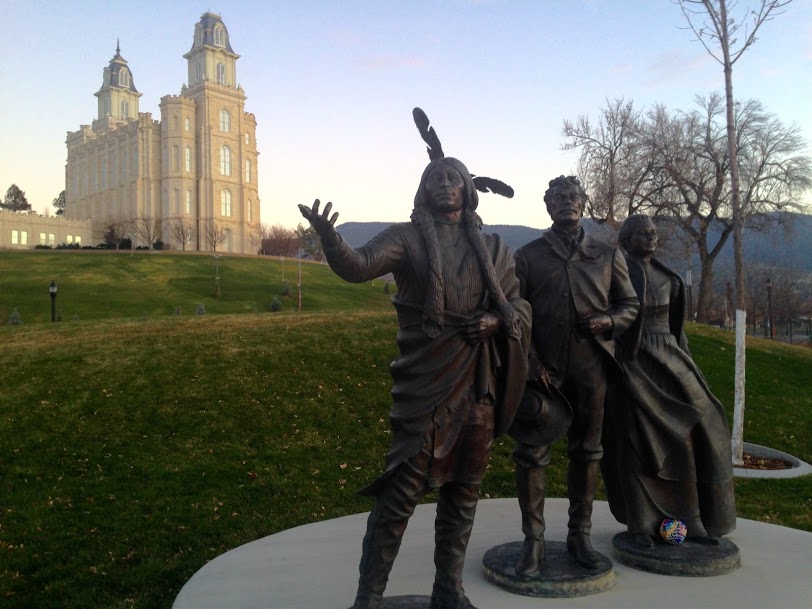
Statue of Walkara in Manti, UT First off, who was Walkara? When the first Mormon settlers arrived in the Salt Lake Valley in 1847, Walkara (alternately spelled as Wakara or Wahkara), best known to the settlers as "Chief Walker," was probably the most powerful and influential man of the American Indian population living in Utah.  By this time, he was believed to be in his late 30s or early 40s, having been born into the Timpanogos Ute tribe in the early 19th century near the Spanish Fork River.  Walkara attained great wealth and notoriety in the 1830s and early 1840s stealing thousands of valuable horses from the ranchos and Catholic missions along the Old Spanish Trail in California, occasionally with the help of trappers like James Beckwourth and Thomas "Peg Leg" Smith.  Fluent in the languages of many indigenous tribes, as well as English and Spanish, Walkara was also known as a skillful trader, sometimes trading in slaves captured from other tribes to Mexic...

A Place in Time: Utah History in Context - 13000-12500 B.C.

Image
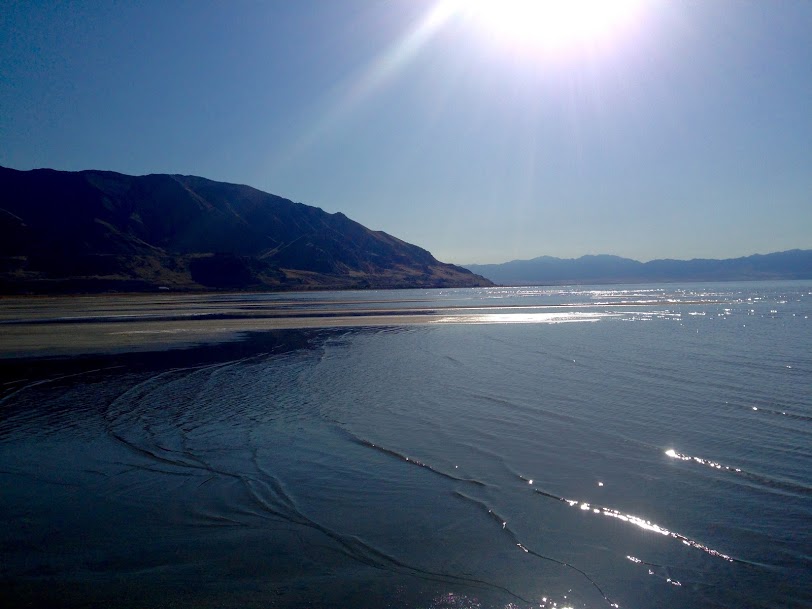
The Great Salt Lake 15,000 years ago, before any humans are known to have inhabited the area, Lake Bonneville covers some 32,000 square miles from its northern tip in Southern Idaho to its southern tip in Southern Utah, and its western extremity in Eastern Nevada to its eastern extremity in Central Utah.  At its maximum depth, it is over 980 feet deep.  The climate is cool and wet, and the valleys in Utah west of Wasatch Mountains are submerged deep under the lake.  After recent lava flows have diverted the flow of rivers in Southeastern Idaho into the lake, Bonneville's levels rise even higher, seeping through the barrier at the Portneuf and Bannock Mountains.  At first the leaking is gradual, until suddenly one day, the barrier is broken.  The massive power of Lake Bonneville is unleashed at 33 million cubic feet per second in a 410-foot wave, blasting through the Snake River Plain at 70 miles per hour and reshaping the land.  The 600-foot Snake Rive...

A Place in Time: Utah History in Context - 1200-1300 A.D.

Image
Medieval Castles in Utah Utah, 13th Century A.D. At an unknown date, sometime between A.D. 1200 and 1300 (according to the National Park Service), during what is called the Pueblo III Period, the Ancestral Pueblo people (also known as "Anasazi") were constructing multi-story stone towers that still stand to this day in the Four Corners area.  Their culture in the area dated back to the around 500 A.D., but around 1100, their communities transitioned from mesa tops to canyons.  One cluster of villages comprising about 2,500 people, now called "Hovenweep" (from a Paiute/Ute word meaning "deserted valley"), is built overlooking the canyons around the Cajon Mesa of the Great Sage Plain near the southern end of Utah's and Colorado's shared border.  The exact purpose of their brick structures is no longer known, whether they were homes, defensive structures, observatories or something else entirely.  Not all that long after, toward the end of the ...